Estate Agent Conveyancing Integration: What to Look For in a Provider
11 November 2026 • 5 min read
Picture a buyer whose offer has just been accepted through your branch. They click the conveyancing link on your site, land on a page they don’t recognise, retype details they have already given you, and wait for an email. Meanwhile your sales progressor has no idea whether anyone has been instructed. Integration exists to close that gap.
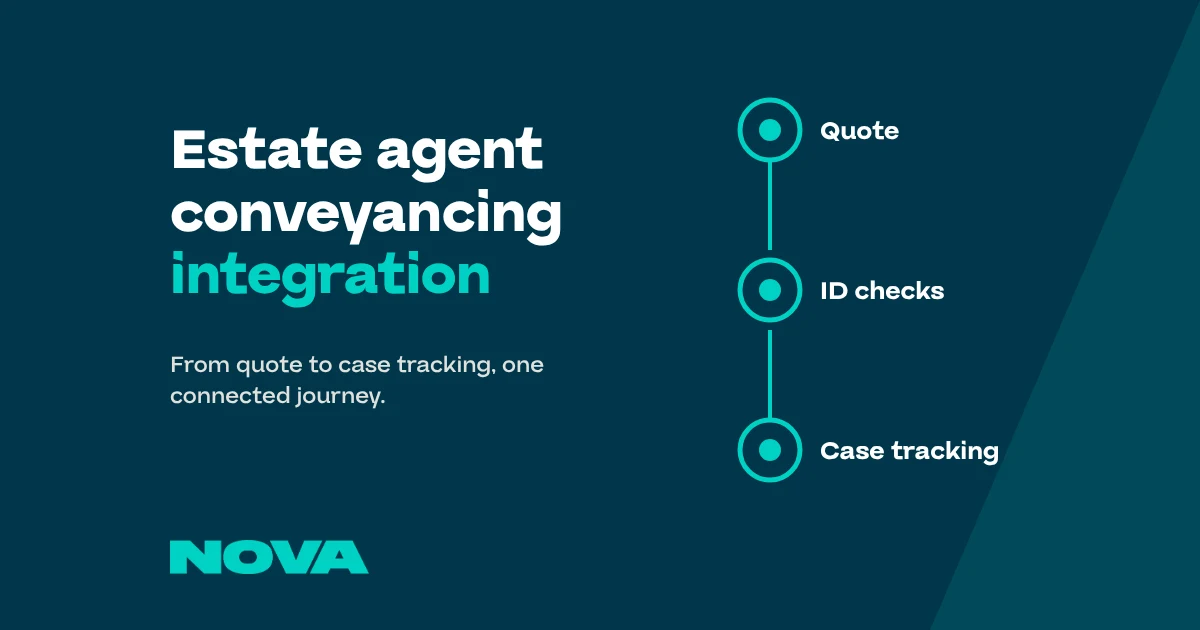
In practice, it means a client can get a quote, instruct, and complete ID checks inside your journey, and you can see progress without chasing. Nova Conveyancing offers an API-connected quote form, a referral form or dedicated landing page, and a named relationship manager for each referring partner.
What integration means in practice
Integration is a spectrum. At one end sits a printed panel list with a phone number. At the other sits an API-connected quote form that sends milestones back to you as a case moves along. Most providers fall somewhere in between, which is why two firms can both say they are “integrated” and offer very different experiences.
The benefit is practical. Clients enter their details once, and you keep sight of cases you would otherwise lose track of.
What good looks like
Five points tell you most of what you need to know. Use the questions in the right-hand column when you speak to a provider.
| What to look at | What good looks like | A question to ask |
|---|---|---|
| Quote route | The client gets a quote from your site or a landing page in your branding | Does your quote form connect to our website by API, or does the client move to a separate page? |
| Data handover | Details the client has already given arrive pre-populated | Which details do you receive, and does anyone have to retype them? |
| Identity checks | The client completes ID checks digitally, at a time that suits them | Which provider do you use, and can the client do it on a phone? |
| Case visibility | You can see milestones without ringing the firm | How will we see progress: a portal, a report, or updates to our sales progressor? |
| Named contact | One person owns your relationship | Who is our contact, and who covers when they are away? |
How Nova Conveyancing connects to your instruction journey
We offer three routes, and all of them feed one case management system. You can put a dedicated quote form on your own landing page, which sends enquiries to us by API. You can use a referral form that captures your name as the referrer. Or you can use a dedicated landing page.
From there, cases are tracked in Hoowla and clients complete ID checks through Thirdfort. Our sales progression team chases the other parties in the chain, and every referring partner, from a single branch to a network, has a named relationship manager. You can see what partners say on our reviews page and read our service commitments in the customer charter.
Why the government’s roadmap raises the stakes
The government’s home buying and selling reform roadmap, published on 19 June 2026, starts from two figures. A purchase takes around 120 days on average from offer to completion, and around one in three transactions falls through.
To tackle that, the roadmap plans sales packs that sellers provide before listing, wider use of digital ID and electronic signatures, and anti-money laundering checks that can be shared instead of repeated. Some of this is voluntary today. Legislation for sales packs will follow “when parliamentary time allows”, and most of the digital ID and e-signature work is scheduled for 2027 to 2028.
Binding conditional contracts come later still. They would tie parties in earlier than exchange, but only once sales packs are embedded, and no date is set. Until then, buyers and sellers in England and Wales can normally still withdraw before exchange.
For agents, the practical point is simple. A provider whose systems already pass data cleanly will find these changes easier to adopt, and you will spend less time re-keying information when they arrive.
How to test a provider before adding it to your panel
A demonstration only shows you the best case, so try the journey yourself.
- Request a quote on both a phone and a desktop, and note how many fields you have to complete.
- Instruct on a dummy or low-risk case.
- Complete the ID checks as a client would.
- Confirm exactly how progress is shown to you.
- Ask for the firm’s regulatory status and complaints route in writing.
Our relationship managers will walk you through our set-up before you send any live instructions.
Where to start
Decide which parts of the journey cost you the most time, whether that is re-keyed data, ID checks, or updates, and look for a provider that connects those first and gives you one person to call. If you would like to see how it would work on your own site, partner with us.
Several do, and the depth varies from a simple link to a form that passes data both ways. Ask each provider to show you a live example instead of describing one.
API stands for application programming interface, the connection that lets two systems pass information to each other. An API-connected quote form exchanges data directly with your website or system, so clients stay in your journey instead of moving to a separate site.
Usually in one of three ways: through the provider’s case tracking, in reports from a relationship manager, or through updates to your sales progressor. Nova Conveyancing tracks cases in Hoowla.
They can save a client a branch visit or a postal certified copy, which removes some admin. We don’t promise a faster completion, because how long a case takes depends on the people and parties involved.
bout this article
Written by: the Nova Conveyancing team
Last reviewed: 16 November 2026
Fact checked against: the government’s home buying and selling reform roadmap (published 19 June 2026) and Nova Conveyancing’s current instruction routes, case tracking, and ID verification set-up.
This article is general information about how conveyancing integration works and is not legal advice. Government plans described here are subject to change.
Nova Conveyancing is a trading name of Connect2Law Ltd, which is authorised and regulated by the Council for Licensed Conveyancers (CLC), number 2774.
You might also like
A conveyancing partner can look right on paper and still leave your branch chasing ...

By Michael Grimsley, National Account Manager, at Nova Conveyancing Every autumn, the same pattern ...