How estate agents can choose a conveyancer to reduce property fall-throughs
28 October 2026 • 5 min read
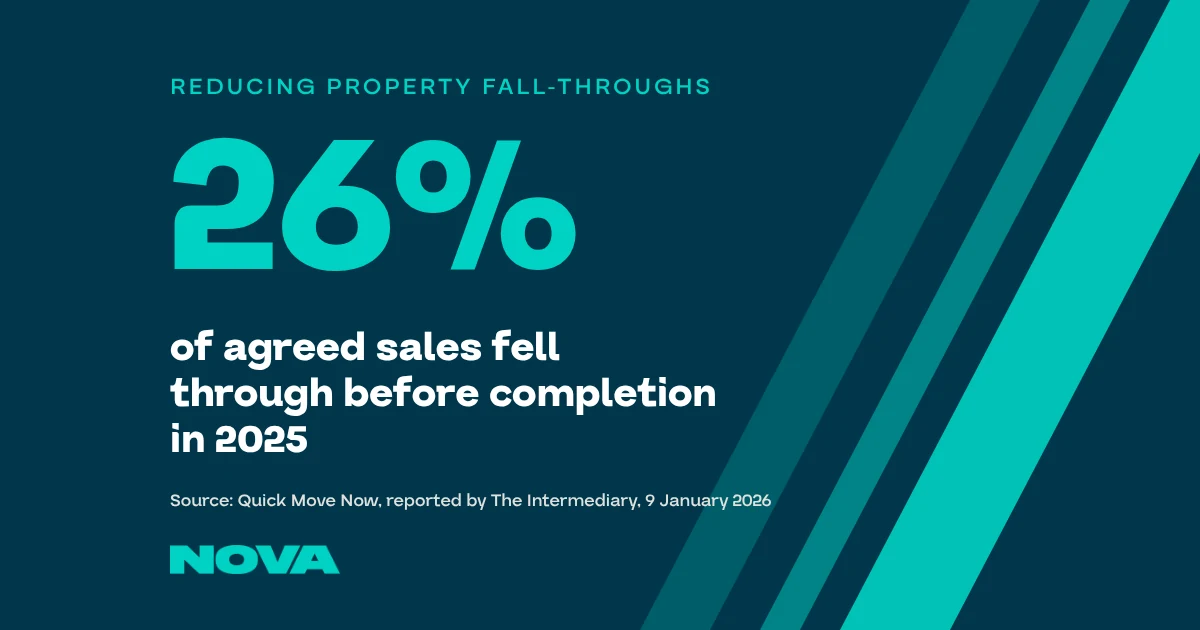
Conveyancing cannot remove every fall-through, because buyers change their minds and lending decisions sit outside any conveyancer’s control. It can influence the fall-throughs tied to late surprises, silence and poor visibility, so agents should choose a provider on early checks, communication standards and what happens when a case struggles.
To reduce property fall-throughs, an agent has to separate the causes a conveyancer can affect from the ones it cannot. Quick Move Now figures reported by The Intermediary show 26% of agreed residential sales falling through before completion in 2025, and Rightmove has put a cost on what that does to agency revenue. This guide looks at what the data says, which conveyancing practices are worth testing, and how to read any provider’s claims about fall-through rates.
Why do property sales fall through in the UK?
According to Quick Move Now’s 2025 figures, 36% of fall-throughs were down to buyers changing their minds, 33% to mortgage difficulties, 18% to problems after surveys and 13% to chain breaks. Some of these overlap with conveyancing, such as survey issues and chain management, but a conveyancer cannot control a buyer’s confidence or a lender’s decision.
The commercial effect on agencies is large. Rightmove estimated almost £392m of potential commission in England lost to fall-throughs, reported in February 2026. That figure applies a 6% rate, which counts sales that fall through and are not back on the market within 12 months, and Rightmove presents it as potential revenue and not confirmed losses. It also notes that a further 23% of sales fall through at first and later complete, which is a reminder that a collapse followed by a re-sale still costs the agent time.
How can a conveyancing service reduce the risk of a fall-through?
A conveyancing service can reduce fall-through risk by finding problems early, keeping every party informed and giving the agent time to act. It cannot guarantee that a sale completes. What it can do is shorten the gap between a problem arising and the agent knowing about it, which is when recovery is more likely.
Four practices are worth testing with any provider, and each is described here as Nova Conveyancing applies it.
- Front-loaded checks. Nova Conveyancing moves identity verification, anti-money laundering checks and source of funds online at the start of the case, so that issues which would otherwise surface late are raised while the parties are still engaged.
- Chain-aware handling. Nova Conveyancing handles cases with the rest of the chain in view and gives agents milestone visibility, which helps a branch set expectations with sellers and buyers whose own moves depend on the sale.
- Defined communication standards. Nova Conveyancing sends proactive weekly updates with live case visibility, gives each partner a relationship manager and each client an account manager, and sets out clear escalation routes, so an agent knows who to call when a case slows.
- Case review. When a transaction stalls or falls away, a dedicated audit looks for root causes and feeds improvements back into live and future cases.
A shorter timeline gives circumstances less time to change. Nova Conveyancing offers a fast-track option with timeframes starting from 7 weeks to exchange, depending on the case. Speed on its own does not make a transaction safer, and it depends on every party in the chain, so it works best alongside the practices above.
What should agents ask a conveyancer about fall-throughs?
Ask when problems are raised, how the agent hears about them, who owns the response and what the firm learns from collapsed cases. The answers show whether a provider is built to catch issues early or only to process files.
| Question | Why it matters |
|---|---|
| Which checks happen at instruction, and which wait until later? | Late discovery of an ID or source of funds issue is a common source of avoidable delay |
| How will we hear about a problem? | Silence is read as risk, and an agent who finds out late has less room to act |
| Who owns the response when a case stalls? | A named person with an escalation route keeps a case from drifting |
| What can we see without asking? | Live case status reduces chasing and lets a negotiator plan ahead |
| What happens after a sale falls through? | A review that changes live cases shows the firm learns from collapses |
| What does the client pay if the sale does not complete? | Fee terms affect how a client feels about proceeding |
How should agents judge claims about fall-through rates?
Treat any claimed reduction in fall-throughs as something to test, and ask for the definition, the period and the sample behind it. Published figures use different definitions and cover different periods, so two numbers that look contradictory can both be right.
The 26% figure from Quick Move Now counts agreed transactions that fell through before completion in 2025. Rightmove’s 6% counts sales that fell through and did not return to market within 12 months, with a further 23% falling through and completing later. A provider quoting a percentage improvement needs to say which of these it is measuring, over what period and across how many cases. Nova Conveyancing’s reviews page shows what agents say about the service, which is a useful check alongside any figures a provider supplies.
What matters most when comparing providers
Fall-throughs have many causes, and a conveyancer is one influence among several. The more useful question for an agent is whether a provider will tell them early, in plain terms, when a case is at risk, and whether somebody will own the next step. A firm that can show how it handles a difficult case gives an agent more to rely on than one that quotes a rate. Agents who want to talk through how this works in practice can start on the Partner with Us page.
No. A conveyancer acts on the client’s instructions and cannot prevent a buyer or seller from changing their mind. What a conveyancer can do is raise issues early, explain each step clearly to the client, and tell the agent promptly when something shifts, so the agent can speak to the client while there is still time to act.
Under No Move, No Legal Fee, Nova Conveyancing’s clients pay legal fees only if the transaction completes, excluding third-party costs. Terms apply. Agents should check what is and is not covered for each client, because the arrangement affects how a client feels about proceeding with a sale.
Nova Rocket targets exchange in 7 weeks (for freehold properties) or 9 weeks (for freehold properties involving a management company and leasehold properties) while providing senior legal oversight, real-time tracking, and a fee-backed guarantee. Learn more here.
You might also like

There is no single best conveyancing service for every hybrid estate agency, because the ...

By Cara Stanbridge, Head of Relationship Management at Nova Across the UK property market, ...